Innovation
Model behaviour: When AI-native pricing meets SaaS
- Innovation
- Article
- 8 minutes read



For two decades, SaaS incumbents have built predictable businesses on a simple idea: sell access (usually per-seat), lock in annual contracts, and let software scale with strong operating leverage.
AI-native businesses are challenging that playbook—not necessarily with better UI, but with different economics.
When revenue is tied to consumption (tokens, inferences, API calls) or outcomes (tickets resolved, documents processed, workflows completed), the product can scale faster than headcount - but the cost base can scale too. It’s a significant shift that’s not only raising the bar of what “good” looks like in the space, but forcing incumbents to adapt.
In this article we explore the way AI-native businesses are changing the standard SaaS revenue model, the core principles underlying these shifts, and the durability of various models to get to an objective answer to the question everyone’s asking: will AI “eat” SaaS, or can they co-exist?
To appreciate the impact of AI-native models, it’s important to understand how the “old guard” was built.
Traditional SaaS is built for multitenancy and scale. Costs are mostly fixed (engineering, support, infrastructure), and cloud hosting is typically a modest share of revenue (often cited as ~5–15%), enabling mature gross margins in the 70–90% range. That’s an important reason why per-seat pricing and annual contracts became the default: they match the cost structure and create forecasting confidence.
AI-native revenue models might look contractual, but they behave like compute models, with companies often monetising in different ways, like:
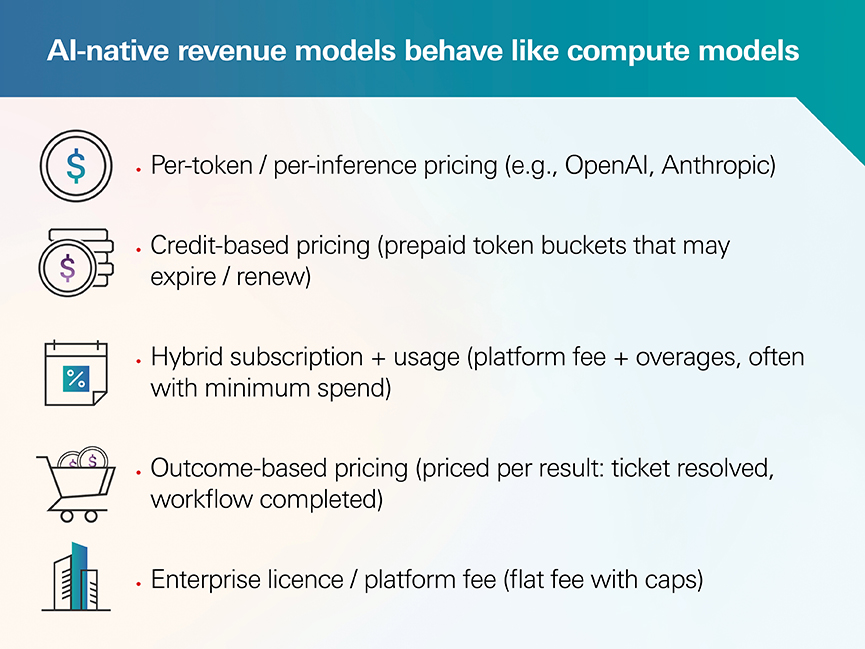
The underwriting reality (and the strategic reality) is that AI-native revenue and cost can scale together. Inference costs can be material - often 30-60% of revenue early on. That means gross margins may start lower (often 40-70%) and don’t automatically improve with scale unless the company actively optimises.
That’s the core disruption: SaaS incumbents are used to selling “access.” AI-native companies increasingly sell “work.”
The shift away from selling access towards selling work is pressuring SaaS incumbents in 3 key areas.
Shifting buyer expectations who now expect to pay for value not just licencing
Buyers are increasingly comfortable with hybrid and usage-based pricing:
That’s a direct challenge to per-seat incumbents: if automation reduces human effort, customers will ask why they’re still paying for the same number of seats.
It creates “invoice shock” and forces new governance muscles
Consumption pricing can be volatile. BetterCloud highlights that scaling AI to production can reveal 500 - 1,000% cost underestimation compared with expectations in the pilot phase. This pushes enterprises to demand:
Incumbents that can’t provide cost predictability (or can’t justify price increases) will face tougher renewals.
It accelerates platform consolidation
BetterCloud argues the market is shifting “from point solutions to platforms,” with IT teams preferring fewer, deeper vendor relationships:
Although AI-native point tools can grow quickly, incumbents with platforms and distribution avenues are not doomed. They can respond by bundling AI, controlling workflows, and using data moats (if the economics allow).
The key question, though, is whether AI and SaaS can co-exist, or whether (as some have predicted) there will be so-called “SaaSpocalypse”
The overwhelming increase into AI-led startups is a strong signal that AI has indeed arrived, but the expectation is not that AI will eradicate SaaS entirely.
Instead, it will likely erode seat-based SaaS margins – unless SaaS businesses evolve. After all, enterprises still need systems of record, stable governance, audit trails and reliable workflows.
What is likely to change dramatically is where monetisation happens.
So what might this relationship look like?
SaaS becomes the system-of-record layer; AI becomes the work-execution layer: SaaS platforms will increasingly act as orchestration hubs where agents pull data, execute tasks, and write back outcomes.
Seat pricing shrinks as a primary value metric: As agentic workflows reduce human touches, “number of users” becomes a weaker proxy for value delivered.
The winners blend predictability with value capture: Pure consumption is flexible but volatile; pure subscription can under-monetise heavy usage. The durable model is the bridge.
In other words: AI and SaaS will be symbiotic—but only after SaaS stops pretending AI is “just another feature” and starts pricing it like a variable-cost engine that delivers measurable work.
The epicentre of this evolution will be in building durable revenue models that lean into different aspects of the SaaS AI symbiosis in varying degrees.
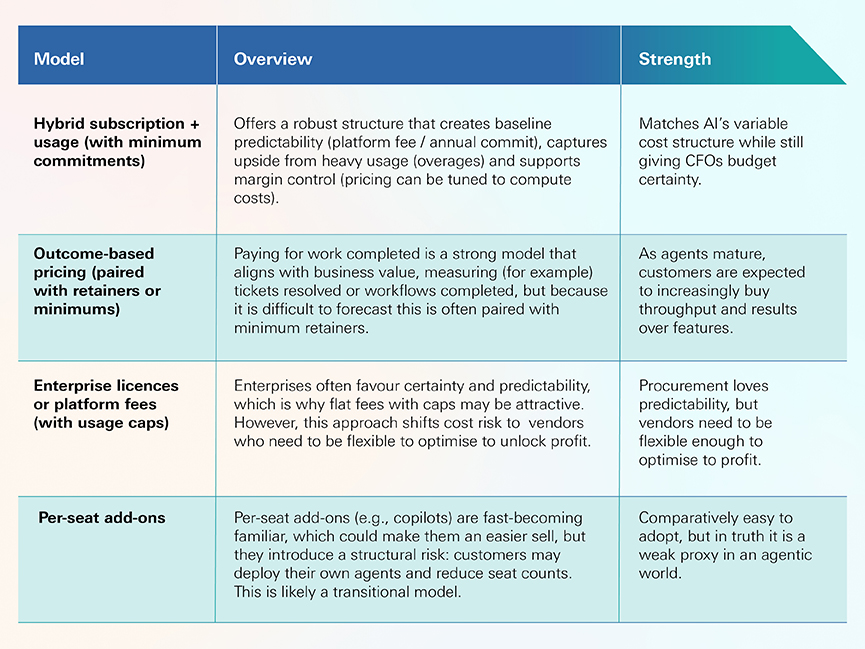
At present, there are 4 likely combinations, outlined below.
Model 1: Hybrid subscription + usage (with minimum commitments)
Viewed the investor- and enterprise-friendly default, a hybrid model offers a robust structure that:
Key strength: it matches AI’s variable cost structure while still giving CFOs budget certainty.
Model 2: Outcome-based pricing (paired with retainers or minimums)
Paying for work completed is a strong model as it aligns with business value, measuring (for example) tickets resolved or workflows completed.
However, because it is more difficult to forecast, there is a need to pare this approach with minimum retainers, clear definitions and measurement metrics, and guardrails around edge cases.
Key strength: As agents mature, customers are expected to increasingly buy throughput and results rather than features.
Model 3: Enterprise licences or platform fees (with usage caps)
Enterprises often favour certainty and predictability, which is why flat fees with caps may be attractive.
However, this approach shifts cost risk to the vendor, which means that it is likely more attractive to business that can aggressively optimise inference costs, work with multiple providers within different models, and who are in a position to maintain strong gross margins despite variable customer usage.
Key strength: Procurement loves predictability, and vendors who are flexible enough to optimise can generate profit vendors with strong optimisation can profit from it.
Model 4: Per-seat add-ons
Per-seat add-ons (e.g., copilots) are fast-becoming familiar, which could make them an easier sell, but they introduce a structural risk: customers may deploy their own agents and reduce seat counts.
This means it will likely be a transitional model. In fact, AI-native companies are already responding by layering usage or outcome pricing into agreements to capture value from agent-driven activity.
Key strength (Temporarily): It is comparatively easy to adopt, but in truth it is a weak proxy in an agentic world.
Adjusting revenue models? A durable, AI-native revenue model will typically demonstrate the below:
Said simply, AI pricing strategy is underwriting strategy. If a model can’t produce predictable margins, it is extremely unlikely to produce durable enterprise value.
The incumbents that thrive will be the ones that stop selling “logins” and start selling “outcomes,” while keeping the predictability enterprises require.
As the space evolves, it’s worth watching out for the following:
The AI-native challengers that endure will be the ones that turn variable compute into expanding margins through optimisation, defensibility, and smart contract design.
Any opinions expressed are merely opinions and not facts. All information in this document is for general informational purposes and not to be construed as professional advice or to create a professional relationship and the information is not intended as a substitute for professional advice. Nothing in this document takes into account your company’s individual circumstances. HSBC Innovation Banking does not make any representations or warranties with respect to the accuracy, applicability, fitness or completeness of this document and the material may not reflect the most current legal or regulatory developments. HSBC Innovation Banking disclaims all liability in respect to actions taken or not taken based on any or all of the contents in this document to the fullest extent permitted by law. Nothing relating to this material should be construed as a solicitation or offer, or recommendation, to acquire or dispose of any investment or to engage in any other transaction.