Growth
Technology sets the pace for global markets
- Growth
- Article
- 3 minutes read



Rising valuations in US tech also pushed investors to diversify, helping non-US markets. With the US dollar weakening, emerging markets, Japanese, European and UK equities all outperformed the S&P 500 in 2025 in dollar terms. The FTSE All World Index, which comprises 4,256 stocks across developed and emerging markets, advanced 23.1% in 2025.2
While investors remain confident of further growth in AI and broader technology themes in 2026, elevated valuations in the US tech sector are attracting greater scrutiny.
At a macro level, equity valuations have surged to all-time highs, as measured by EV/EBITDA multiples, despite only a modest expansion in M2 money supply.3
Lofty valuations are a feature of the private markets, too. After a flurry of big funding rounds, 23 private companies now command valuations that would put them in the S&P 500 index if listed on public markets.
AI investments have also become critical to global economic growth. McKinsey estimates spending on data centres will need to reach almost USD7 trillion by 2030 to keep pace with demand for AI.4
All this, of course, leaves global market sentiment highly dependent on the monetisation of AI investments, with room for disappointment if revenues fall short of projections or demand for compute power eases.
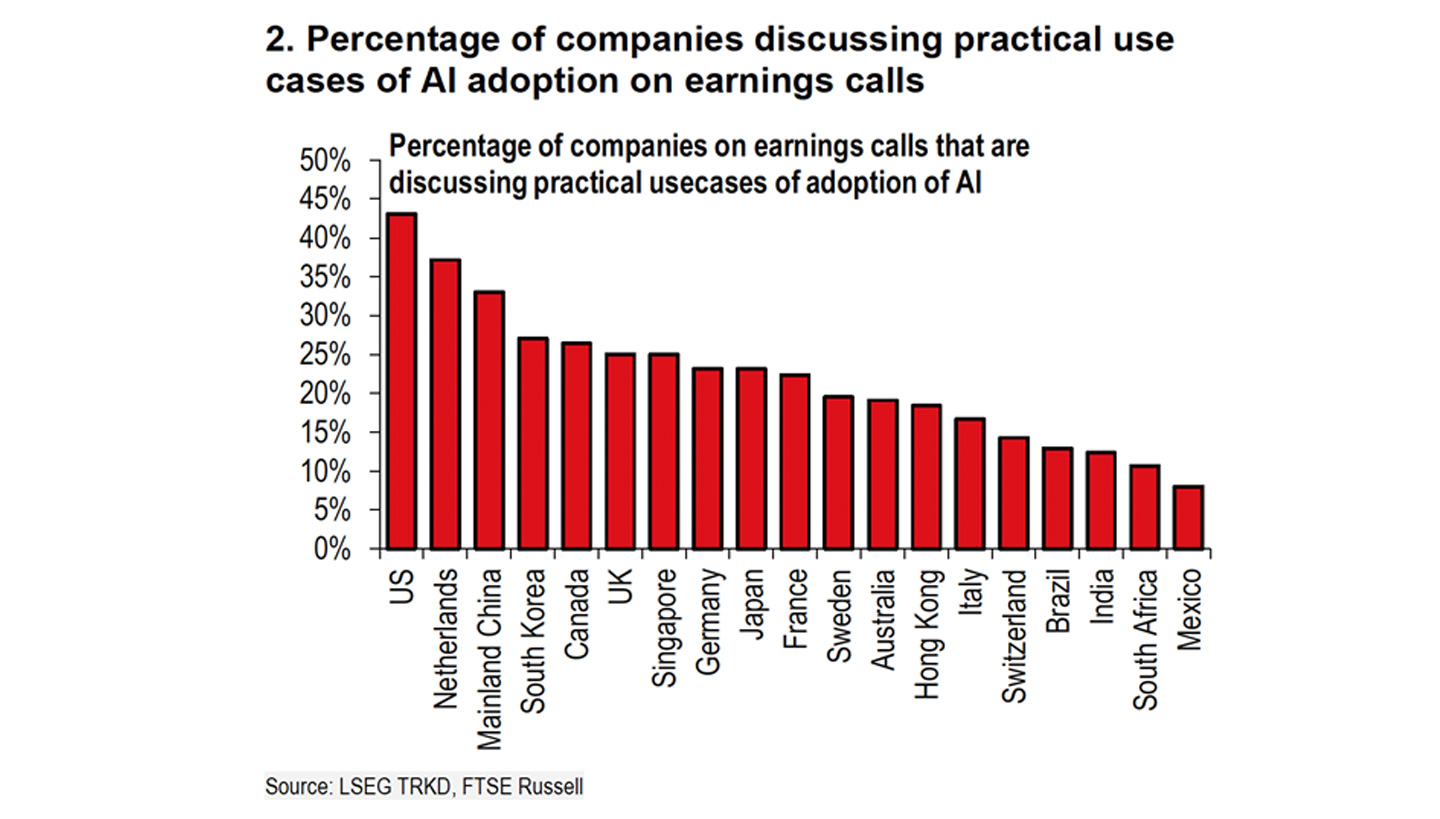
One reason for caution is that AI adoption remains highly US-centric. HSBC Global Investment Research’s analysis of global earnings calls showed that 40% of listed US companies discussed practical AI use cases, well ahead of other markets.5 Some 45% of US companies now pay subscriptions to AI models or tools, according to the Ramp AI index.6
Technological improvements also pose a risk, with signs that AI queries are becoming much more efficient. Any reduction in capex spending from the world’s leading tech firms could have big implications across the entire AI ecosystem.
In this context, 2026 is set to be a pivotal year for technology valuations, as investors increasingly demand evidence that today’s trillions of dollars of investment in AI will deliver sustainable long-term economic returns in the future.
The first weeks of 2026 suggest that confidence in the technology story remains intact. Equity investors are still firmly focused on AI, and tech stocks have continued to perform well.
HSBC Global Investment Research notes that high valuations are supported by improvements in productivity. While clear proof of the impact of AI on earnings is limited, there is evidence that revenues are rising ahead of costs. Even a moderate 1% cost saving from AI adoption could generate nearly USD130 billion across the S&P 500 and raise margins by half a percentage point.7
Alastair Pinder, Head Emerging Markets and Global Equity Strategist at HSBC, expects technology to remain the dominant force in equities in 2026 as AI adoption broadens.
“We expect the AI theme to extend its strength while shifting shape,” he said. “Our view is that the next phase will push deeper into the downstream universe, with AI adopters, software infrastructure players, and non-US AI opportunities taking a more central role.”
Rising AI adoption also requires businesses to focus more on their data, driving demand for a range of technology services.
Despite uncertainty around interest rates, geopolitics and the potential for other shocks, HSBC has a constructive outlook on global equities for 2026, with a preference for international markets over the US. Spending on data centres is driving a global investment cycle, and global funds are hedging their bets on the US.
As global investors increasingly look to diversify beyond the US, the tech sector in Asia Pacific is well placed to benefit from increased capital flows. This extends across the AI ecosystem, from materials and semiconductors to software and platform providers. More modest valuations in Asia Pacific and strong domestic liquidity are also drawing the attention of global investors.
The wave of positive sentiment towards technology is also allowing startups and venture capital investors to benefit from improved access to public markets. The window for public listings reopened in early 2025, allowing many mature startups to generate liquidity for investors. In the US market, more venture-backed companies went public in the first three quarters of 2025 than in 2022-2024 combined.
The improvement in IPO liquidity extends beyond the US. Chinese tech firms are also enjoying renewed access to public markets through Hong Kong – the world’s busiest IPO market in 2025 with over USD35 billion raised from more than 100 new listings.8
HSBC’s most recent Funding the Future Survey, published in December, found that investors have a positive outlook on IPOs in 2026, with 59% of private investors and 55% of public market investors anticipating an increase in IPO activity in 2026.9
Investors in Asia were especially optimistic about IPO activity, with 74% expecting an increase in IPO activity in 2026. Technology is also a preferred theme, with 64% of investors reporting a bullish view.
Private markets investors will be watching liquidity conditions closely in 2026. The survey showed 76% of VC/PE investors are planning to exit one or more of their portfolio companies in the coming year – one more reason, if it were needed, why technology holds the key to overall market sentiment in the months ahead.
This article originally appeared in the Cut Through Venture State of Australian Startup Funding Report, which examines the largest data set available on the Australian startup funding landscape. Click here to read more The State of Australian Startup Funding Report 2025.
Issued in Australia by HSBC Bank Australia Limited ABN 48 006 434 162 AFSL 232595 and The Hongkong and Shanghai Banking Corporation Limited, Sydney Branch ABN 65 117 925 970 AFSL 301737, this document provides general information only and is not an offer, solicitation, or advice that you should enter into any transaction with HSBC. It is based on sources deemed reliable, but not independently verified; HSBC makes no representation or warranty, and disclaims all liabilities, with regard to the document's content.
© HSBC Bank Australia Limited and The Hongkong and Shanghai Banking Corporation Limited, Sydney Branch 2026. All rights reserved; unauthorised reproduction or distribution is prohibited.